Isengrind - Night of Raining Fire, 2012
Track Listing:
1. Lost Girls 0:00
2. Cygnus 7:00
3. Horselberg 11:08
4. Valeria Underground 14:54
5. Nadirs of the Sun 16:48
6. Lit by the Rain 20:49
7. Ascending 24:24
8. White Bone Snake 29:26
9. Spine of the Night 31:10
10. Still Voyager 41:36
20120830
20120826
20120825
20120824
20120823
Vashti Bunyan - 1969 Just Another Diamond Day
All songs written by Vashti Bunyan, except where noted.
"Diamond Day" -- 1:47
"Glow Worms" -- 2:16
"Lily Pond" -- 1:24
"Timothy Grub" -- 3:15
"Where I Like to Stand" (Bunyan / John James) -- 2:21
"Swallow Song" -- 2:16
"Window Over the Bay" (Bunyan / Robert Lewis) -- 1:47
"Rose Hip November" -- 2:27
"Come Wind Come Rain" -- 2:07
"Hebridean Sun" (Bunyan / Lewis) -- 1:13
"Rainbow River" -- 3:22
"Trawlerman's Song" (Bunyan / Lewis) -- 1:56
"Jog Along Bess" -- 3:36
"Iris's Song for Us" (Bunyan / Wally Dix / Iris Macfarlane) -- 1:33
Bonus tracks:
"Love Song" -- 1:58 (B-side to 1966 single "Train Song" produced by Peter Snell)
"I'd Like to Walk Around in Your Mind" -- 2:15 (an unreleased 1967 Immediate Records acetate produced by Mike Hurst)
"Winter is Blue" -- 1:48 (an unreleased acetate from 1966, different from Tonite Let's All Make Love in London version)
"Iris's Song Version Two" (Bunyan / Wally Dix / Iris Macfarlane) -- 2:31 (a 1969 alternative version from John Bunyan's tape)
"Somethings just stick in your mind" -extra track- 2:15
Vashti Bunyan: vocals, acoustic guitar.
Christopher Sykes: piano, organ.
John James: dulcitone.
Robin Williamson: fiddle, whistle, Irish Harp. (8,13)
Dave Swarbrick: fiddle, mandolin & Simon Nicol: banjo (5,9,14)
Mike Crowther: guitar. (17)
String and recorder arrangements by Robert Kirby (1,6,11)
Just Another Diamond Day is the debut album of English singer-songwriter Vashti Bunyan.
In the mid to late 1960s, Bunyan was under contract to Andrew Oldham, which saw her release two singles. However, Bunyan found the experience frustrating, and decided to head for the Scottish islands in search of an artistic commune supposedly established by Donovan. She travelled around the countryside with her partner Robert in a horse-drawn wagon. It was during these travels that she wrote the songs which would later appear on Just Another Diamond Day.
Bunyan returned to London where she was urged by producer Joe Boyd to record her songs while they were still fresh. The recording session took place in December 1969 at Sound Techniques in London. Song arrangements were performed by Robert Kirby, who also worked with Nick Drake. Simon Nicol and Dave Swarbrick of Fairport Convention and Robin Williamson of The Incredible String Band contributed to some tracks. The album was initially released in 1970 but was a commercial failure and Bunyan retired from music for 35 years.
Just Another Diamond Day was re-released by Spinney Records in 2000, its success prompting Bunyan to return to music and eventually record the much delayed follow-up Lookaftering, released in 2005. Just Another Diamond Day was also featured in a UK TV advert for T-Mobile's Flext in 2006.
<紅毛港馬賽克鑲嵌工作室> 8/13(一)~ 8/31(五) 我在這當"砌石美工"
台北當代藝術館_公共藝術專案_藝術家專訪_李億勳
<紅毛港馬賽克鑲嵌工作室> 8/13(一)~ 8/23(23) 我在這當"砌石美工"
http://www.hmg-mosaic.idv.tw/1.htm
8/4(六)投履歷, 8/7(二)中午寄出推薦信, 下午3:00來電通知8/10(六)上午面試, 8/10(六)面試完, 楊經理告知8/13(一)上班.
這期間, 體會剪磚肉體痛的感覺, 心靈痛的感覺, 手起水泡, 長繭. 腰酸腿廢的感覺, 學習畫模型馬賽克, 拼貼... 在這裡, 包括核心主管3人, 共15人, 同仁質感很好, 大多是藝術相關領域大學畢業或研究所畢生, 幾位源來自紅毛港女, 女孩們時髦漂亮, 男孩們溫雅, 時而酷酷的氣質...
佩服這些工作者同仁, 在工廠中, 屈身地板, 以專業技巧快速剪磚, 配色, 混搭, 又有些人執行設計, 3D, 模型, 有些同仁則開始打線放樣, 或手繪細部圖案, 開始按形狀剪磚, 最高莫氏硬度7的地磚, 手拿鉗子喀嚓喀嚓響, 工作氣氛和諧, 從每一天的上午8: 00~ 下午5:00. 我則是肉腳新人, 每天灰頭土臉的回家...
喜歡這份工作, 更喜歡這裡的人們, 在馬賽克工作室過去作品中, 對我而言最有文史意義的是鼓山<拆除中的四海一家>, 最代表高雄的則是高雄捷運公共藝術工程, 文化中心站<精靈樂章>, 前鎮高中站<異質樂園>, 鳳山站潘大謙委託製作<鳳人緣心>.
單純的喜歡, 想向李老師, 楊經理, 郭老師學習去做, 基本功是要練的, 要與莫氏硬度7瓷磚對抗, 手會繼續起水泡, 長繭, 美感訓練是我比較擔憂的, 尤其是配色.
這些擔憂, 怎辦? 原本, 沒想這麼多, 想傻傻的做下去, 直到有一天, 主管說, 妳不行! 動作太慢了, 太老了, 美感太差了... 於是可能被fire掉 (但我想應該不會啦~ 他們不壞且超好的)
昨天, 文藝系學姊和芸打電話來(鳳山社大執行秘書), 詢問我找到工作没? 是的, 打來時正在剪瓷磚, 回家後回訊給她, 她說, 他們鳳山社區大學缺行政人員, 問我有無興趣? 於是今日下班後, 我去讓她面試了... 上班時間下午到晚上.
雖然離棄馬賽克鑲嵌會捨不得, 但我是肉腳, 不知該怎辦? 只好準備好明天向李老師們說明吧!
(離開了, 還是會繼續愛他們的, 這些吃苦耐勞的藝術工作者)
2012. 8. 22 10:50 pm
20120822
Sex Pistols - Who Killed Bill? 性手槍 70年代英國龐克運動
Too Fast to Live, Too Young to Dead
性手槍 70年代龐克樂團
Sex Pistols - Who Killed Bill?
God Save The Queen - The Sex Pistols
20120820
Tirant lo Blanch - Capella de Ministrers & Carles Magraner
Spanish & French music before the XV century
one of my favourites disc of medievale music
Disc 1 : :)
I ) LA TRADICIO CAVALLERESCA
1. Propiñian De melyor - Anonim
2. Ave Maris Stella - J Dunstable
3 II sera pour vous /L'homme arme
4. Alla Bataglia, eu su chavagli - Anonym
5. Sit nomen Domini Benedictum -Anonim
II) TIRANT A ANGLATERRA
6. dit le Borgion -Anonimo
7. Prichasse of youth - Annonimo
8. Alla Caccia, su a cacciare - Annonim Instrumentale
9.- Laliaila ttralura "La Lucha " -P . villa
10 Non noches a moy - B Ycart
11. Haec est victoria "La Guerra " M. Flexa
12. Missa L'Homme Arme : Kyrie -G. Dufay
III) TIRANT A SILIA I RODES
13. L'amor ,dona ,che io te porto anonym grpup of XX century
14. Non Val acqua - B.Trombocno
15. Ayo visto Lo mappamodo - Anonym /J Cornago
IV 9 TRIRANT L'IMPERI GREC
16. Tzivarei - Cango Grega -Instrumentale
17. Trista che espera - P. Oriola
18.- Lloremos ,alma ,lloremos- Anonim Instrumental
19.- Quel Fronte singorille - G. Dufay
20.- Lamentatio sancte matris ecclesiae constantinple- G Dufay
21. Danca - P. Oriola Instrumentale
22 Triumpho De le done - Anonim
23. Cavalacha Snisblado - Anonym Isntumentale
24. Ya tocan los atabales "Las cañas "J. Brudieu
25. Fortuna Despertata - A. Busnois
26. Fortuna Despertata -A Busonis
27. Ferdio esta don Tristan (Contrafactum) J. Urrede
28 La viuda se quiere casar "La viuda " -- M flexta .
Codex Calixtinux
The Codex or Codex Calixtinus Calixtino is an illuminated manuscript Spanish
of the century XII.. Contains sermons, hymns, miracles, stories of the translation of the Apostle, liturgical texts and music pieces related to the Apostle Santiago .
Códice Calixtino - Antifonario Mozárabe\Códice Calixtino - Antifonario Mozárabe
The fifth is a kind of guide for pilgrims following the Way of St. Santiago in Santiago de Compostela travel, tips, and route descriptions of works of art and local customs of the people who lived it along the road.
source :
http://es.wikipedia.org/wiki/Codex_Calixtinus
20120819
From A to X (deutsch) - John Berger
Hörspiel - Hörbuch - deutsch - komplett
From A to X
West-östlicher Divan: Utopie und Wirklichkeit
Von John Berger
Xavier ist verurteilt, zweimal lebenslänglich, und seine Geliebte A'ida schreibt ihm Briefe. Die Magie ihrer Worte - eine Beschwörung der Lust und des Lebens - ist stärker als die Gefängnismauern.
Das Schreiben stärkt ihren Widerstand gegen Gewalt und Zerstörung.
Auf der Rückseite der Briefe hat X seine Gedanken notiert. So entsteht ein heimlicher Dialog. Die Liebesgeschichte der beiden scheint im nahen Osten angesiedelt, könnte aber überall auf der Welt spielen, wo Diktatur und Willkür herrschen.
"Eine der zärtlichsten und ergreifendsten Geschichten, die ich seit Jahren gelesen habe." (Harold Pinter)
Aus dem Englischen von Hans-Jürgen Balmes
Bearbeitung und Regie: Ulrich Gerhardt
Komposition: Daniel Dickmeis
Mit Bibiana Beglau und Wolfgang Michael
DLF 2011/75'29 (Ursendung)
John Berger et Juliette Binoche pour De A à X
Juliette Binoche de A à Z: partie 1 ( A a G )
Juliette Binoche de A à Z: partie 2 ( H a M )
Juliette Binoche de A à Z: partie 3 ( N à T )
Juliette Binoche de A à Z: partie 4 ( U à Z )
"De A à X", extraits
En partenariat avec Festival d'Avignon
A pour Aïda, X pour Xavier. Il est en prison, condamné à perpétuité ; elle poursuit son quotidien de pharmacienne et lui écrit. Une correspondance à sens unique, qui se transforme en journal intime puisque Xavier a pris l'habitude de noter, au revers des lettres d'Aïda, ses réflexions sur sa détention, sur sa vie d'avant, sur ce que fut son engagement. On devine alors qu'il a été écroué pour des raisons politiques, sans doute pour faits de terrorisme. De A à X est l'ensemble de ces lettres « miraculeusement » retrouvées par John Berger, dont certaines n'ont jamais été envoyées. Dans cet échange épistolaire, nul pays n'est clairement désigné, nul mouvement révolutionnaire précisément identifié. Ainsi s'installe l'universalité du propos de ce qui se révèle être le roman d'un amour franchissant toutes les barrières. Grâce aux mots d'Aïda, Xavier réintègre le monde extérieur et s'évade hors des murs qui l'entourent. De A à X est un vibrant hommage à la force de ces mots qui, au-delà de la cellule 73 dans laquelle un prisonnier paye le prix de ses convictions politiques, font souffler un inaliénable vent de liberté. Pour cette lecture dans la Cour d'honneur du Palais des papes, Juliette Binoche sera la voix de cette femme amoureuse et Simon McBurney celle du condamné qui ne renie rien de ses combats. C'est l'auteur John Berger qui prendra lui-même en charge le prologue de ce texte, où la critique féroce d'un système totalitaire le dispute aux déclarations enflammées, où le politique et l'amour s'enlacent à l'infini. JFP
À propos de...
- Spectacle(s) : De A à X
- Auteur(s) : John Berger
- Metteur(s) en scène : John Berger
- Acteur(s) : John Berger, Juliette Binoche, Simon McBurney
Détails de la vidéo
- Langue : français
- Durée : 2 minutes 14 secondes
- Lieu : Avignon (Cour d'honneur du Palais des papes)
- Copyright : Festival d'Avignon / La Compagnie des Indes
- Ajoutée le 20/07/2012
- Type : Extrait (document vidéo)
20120817
今日駁二看 IIIDOL 我我偶像
因為高師大李老師的推薦, 今天與李老師全家, 新公司楊經理, 另外2位同事下了班一起前往駁二看 "李明道 (AKIBO) 蕭青陽 IIIDOL 我我偶像-新型唱片美學展" , 特別是今天由李明道老師親自解說他的設計概念, 與音樂人之間互動的趣聞.
李明道 (AKIBO)的唱片設計, 早期從滾石開始, 有陳昇, 伍佰, 黑名單工作室, 五月天... 太多太多了, 而那些音樂, 那些唱片設計, 熟悉的符號, 憶起過往..., 聽到設計者親自解說最後, 忍不住躲在黑暗角落流淚了, 為了什麼? 都有.
這展覽, 又感動到了
IIIDOL 我我偶像
李明道 (AKIBO)的唱片設計, 早期從滾石開始, 有陳昇, 伍佰, 黑名單工作室, 五月天... 太多太多了, 而那些音樂, 那些唱片設計, 熟悉的符號, 憶起過往..., 聽到設計者親自解說最後, 忍不住躲在黑暗角落流淚了, 為了什麼? 都有.
這展覽, 又感動到了
IIIDOL 我我偶像
有一天,我會和我的偶像一同老去。
最後一盞燈
作詞 陳昇
作曲 陳昇
總在秋風吹來冷冷的夜裡 漫步在分手的地方
想要分辨來的人是不是妳 問問妳是否還哭泣
對著電話我想解釋我自己 告訴妳我多麼想妳
將妳輕輕擁抱溫柔靠著我 讓明天鎖在門後
在沒有人跡冷冷夜空裡 尋覓著最後一盞燈影
當門扉悄悄打開的時候 擁抱妳直到天明
電話裡有輕輕哭泣的聲音 妳說妳不能等待我
站在街燈潺潺淹沒的街頭 我彷彿已不是我
所有等待都是為了妳 我無法改變我自己
怕妳不能一個人獨自生活 愛一個人 沒有錯
總在秋風吹來冷冷的夜裡 漫步在分手的地方
是否妳的門早已經換了鎖 彷彿我已不是我
在沒有人跡冷冷夜空裡 尋覓著最後一盞燈影
當門已悄悄掩上的時候 要哭泣直到天明
電話裡有輕輕哭泣的聲音 妳說妳不能等待我
想要問妳是否能再見一面 妳是我最後的一盞燈
20120814
TwinSisterMoon - The Hollow Mountain (2009)
TwinSisterMoon - The Hollow Mountain (2009) [Full Album]
Track Listing:
1. Druids 0:00
2. Sun Snaring 4:28
3. Errand 8:51
4. The Hollow Mountain 11:14
5. Walhalla 13:57
6. Bride of the Spirits 20:04
7. Unseen Seen 21:23
8. To the Green Pastures (Of the Land of the Dead) 23:50
9. Conjuring / Doomed Me in Skies to Dwell 32:05
.
20120808
資深藝術家影音紀錄片 - 陳景容
資深藝術家影音紀錄片 - 陳景容 Part I 1/3 HD
資深藝術家影音紀錄片 - 陳景容 Part II 2/3 HD
資深藝術家影音紀錄片 - 陳景容 Part III 3/3 HD
行政院文化建設委員會,規劃「台灣資深藝術家影音紀錄片」系列製作,紀錄前輩藝術家個別的生活、創作理念與作品,展現其藝術之貢獻與風範,讓社會大眾瞭解台灣藝術家們辛勤耕耘和所付出的心力,以推動文化建設和促進藝術教育的發展,加強民眾的藝術素養。
跟著鏡頭往返台北 - 巴黎,直探生活面向看見陳景容將生命與熱情投入油畫、壁畫及馬賽克的藝術殿堂,更化為行動,在物換星移的流光歲月,豎立永恆價值。
連結: 大師的足跡陳景容數位美術館
.
20120807
馬賽克藝術的歷史 The history of mosaic art - Mosaics in the ancient world
2011. 10/7 - 10/19 高空大文藝系舉辦了- 西班牙Grand Tour12天! 西班牙十月天氣: 北部約30-12度, 南部約33-14度, 與我們同遊 1. Mystical North; 2. Moorish South; 3. Dark Heart
我們一行30人造訪了西班牙, 北, 南, 中部, 世界文化遺產和皇宮, 聚落, 建築群... 等等. 西班牙受到伊斯蘭摩爾文化影響深遠, 包含Barcelona現代建築師- Antonio Gaudí (高第), 同樣是受了此影響. 西班牙建築風格, 至古至今, 被她深深影響著, 融入成特有的Mudeja 風格 (混合建築風格), 到處皆是mosaic (馬賽克) 藝術, 從路面, 地板, 鑲嵌在任何一處, 鑲嵌在西班牙生活之中.
我愛極了馬賽克藝術.
Spain20111011_Day5 相片
https://picasaweb.google.com/116390827662876321064/Spain20111011_Day5
以下文章內容, 取自英國網站-
Mosaics and mosaic making information from The joy of shards Mosaics Resource
http://www.thejoyofshards.co.uk/index.shtml
The history of mosaic art - Mosaics in the ancient world
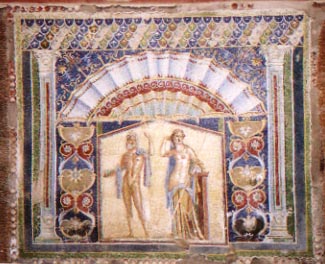
The history of mosaic goes back some 4,000 years or more, with the use of terracotta cones pushed point-first into a background to give decoration. By the eighth century BC, there were pebble pavements, using different coloured stones to create patterns, although these tended to be unstructured decoration. It was the Greeks, in the four centuries BC, who raised the pebble technique to an art form, with precise geometric patterns and detailed scenes of people and animals.
By 200 BC, specially manufactured pieces ("tesserae") were being used to give extra detail and range of colour to the work. Using small tesserae, sometimes only a few millimetres in size, meant that mosaics could imitate paintings. Many of the mosaics preserved at, for example, Pompeii were the work of Greek artists.
The mosaic here shows the god Neptune with Amphitrite (on the right) and is in Herculaneum, Italy. It is a wall mosaic which uses pieces of glass to give the vivid colours and reflect light. Glass was not suitable for floor mosaics. Here, the tesserae were mainly small cubes of marble or other stone. Sometimes bits of pottery, such as terracotta, or brick were used to provide a range of colours.
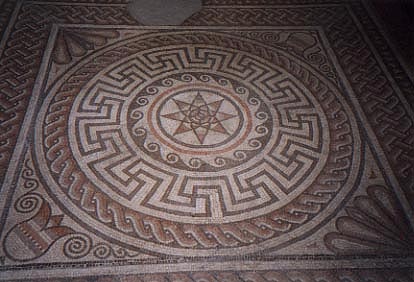
The expansion of the Roman Empire took mosaics further afield, although the level of skill and artistry was diluted. If you compare mosaics from Roman Britain with Italian ones you will notice that the British examples are simpler in design and less accomplished in technique.
Typically Roman subjects were scenes celebrating their gods, domestic themes and geometric designs. The inter-twined rope border effect here is called "guilloche".
This mosaic is in the museum at Winchester, Hampshire, UK.
Byzantine mosaics
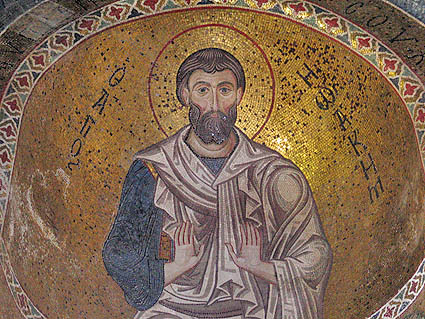
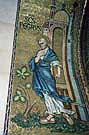
With the rise of the Byzantine Empire from the 5th century onwards, centred on Byzantium (now Istanbul, Turkey), the art form took on new characteristics. These included Eastern influences in style and the use of special glass tesserae called smalti, manufactured in northern Italy. These were made from thick sheets of coloured glass. Smalti have a rough surface and contain tiny air bubbles. They are sometimes backed with reflective silver or gold leaf.
The mosaic below is from the ceiling of the baptistery in Florence, Italy. Other spectacular examples can be found in Ravenna, Venice and Sicily and in Istanbul.
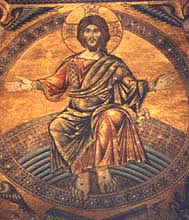
Whereas Roman mosaics were mostly used as floors, the Byzantines specialised in covering walls and ceilings. The smalti were ungrouted, allowing light to reflect and refract within the glass. Also, they were set at slight angles to the wall, so that they caught the light in different ways. The gold tesserae sparkle as the viewer moves around within the building.
Roman images were absorbed into the typical Christian themes of the Byzantine mosaics, although some work is decorative and some incorporates portraits of Emperors and Empresses.
Islamic mosaic art
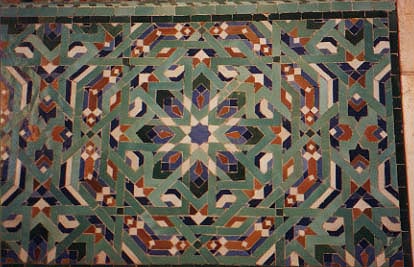
In the west of Europe, the Moors brought Islamic mosaic and tile art into the Iberian peninsula in the 8th century, while elsewhere in the Muslim world, stone, glass and ceramic were all used in mosaics. In contrast to the figurative representations in Byzantine art, Islamic motifs are mainly geometric and mathematical. Examples can be seen in Spain at the Great Mosque at Cordoba and the Alhambra Palace. In Arabic countries a distinctive decorative style called zillij uses purpose-made ceramic shapes that are further worked by hand to allow them to tessellate (fit together perfectly to cover a surface).
The British Association for Modern Mosaic has an excellentlist of sources on ancient mosaics.
Found objects have been used as mosaic materials in a range of ways, for example in Victorian shell grottoes and "putty pots", where china and other items (buttons, toy figures etc) are stuck to a base with linseed putty. This kind of collage of personal objects with connections to everyday life is also sometimes called "memoryware".
Mosaic history, part 2 - Medieval to modern
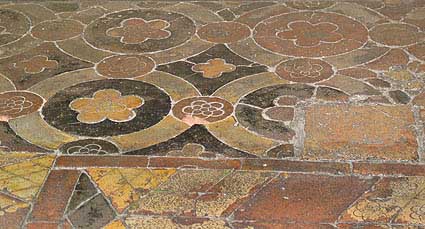
In the rest of Europe, mosaic went into general decline throughout the Middle Ages. However a flourishing tile industry led to mosaic tiling patterns in abbeys and other major religious buildings, for example. These tiles from Prior Crauden's Chapel at Ely Cathedral date from around 1320. The floor of the Chapel features a detailed tiled scene of Adam and Eve. As well as the interlocking patterns of tiles, there are some other mosaic techniques, including pseudo mosaic and opus sectile
In the 19th century there was a revival of interest, particularly in the Byzantine style, with buildings such as Westminster Cathedral (left) and Sacre-Coeur in Paris. In Britain, this was fuelled by the concentration of wealth that the Victorian era brought, with increased domestic and public building projects. New techniques for mass-producing tiles meant a renewed of interest in decorative floors. The Gothic Revival in architecture and design looked back to medieval themes – and this was reflected in the way tiles and mosaic were used. Another industrial influence was Antonio Salviati, who is credited with breathing new life into the Venetian glass industry. He saw the business opportunity in matching the ancient skills practised in Venice with the Victorian demand for glass mosaic.
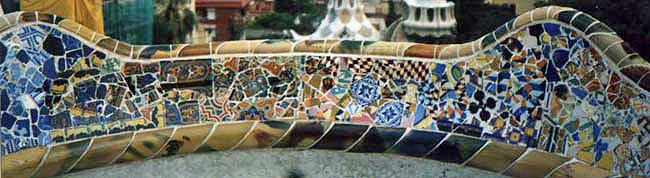
The Art Nouveau movement also embraced mosaic art. In Barcelona, Antoni Gaudi worked with Josep Maria Jujol to produce the stunning ceramic mosaics of the Guell Park (below) in the first two decades of the 20th century. These used a technique known as trencadis in which tiles (purpose-made and waste tiles) covered surfaces of buildings. They also incorporated broken crockery and other found objects, a revolutionary idea in formal art and architecture.
Found objects have been used as mosaic materials in a range of ways, for example in Victorian shell grottoes and "putty pots", where china and other items (buttons, toy figures etc) are stuck to a base with linseed putty. This kind of collage of personal objects with connections to everyday life is also sometimes called "memoryware".
A very influential site has been La La Maison Picassiette (in Chartres, northern France), the idiosyncratic work of Raymonde Isidore between 1938 and 1964. As a middle-aged manual worker, he covered his entire house and garden with intricate mosaics of broken crockery. His nickname ("Picassiette") came from a French expression meaning a "scrounger": This expression - "pique assiette" - is the name given today to this very popular style of mosaic.
Modern mosaics
Mosaic is in a healthy state in the early 21st century, despite a tendency for it to be thought of as more the work of craftspeople than artists. Perhaps this is a difficulty in accepting the fact that mosaics often have a dual function, for example as flooring, and also because it is a very accessible, non-elitist form of creativity. The field is rich with new ideas and approaches, and organisations such as the British Association for Modern Mosaic and The Society of American Mosaic Artists exist to promote mosaic. BAMM has an excellent list of sources on ancient mosaics. The worldwide web gives access to a great many artists working in this medium.
20120806
Caucasus region - "Oldest Georgian Chants" 1970
Caucasus region - "Oldest Georgian Chants" (Documentary film), 1970 高加索地區- 最古老的喬治亞聖歌(紀錄片)
"Oldest Georgian Chants" (Documentary film)
Directed: Soso Chkhaidze
(c) Georgian TeleFilm (Kartuli Telepilmi)
.
"Oldest Georgian Chants" (Documentary film)
Directed: Soso Chkhaidze
(c) Georgian TeleFilm (Kartuli Telepilmi)
.


