2011. 10/7 - 10/19 高空大文藝系舉辦了- 西班牙Grand Tour12天! 西班牙十月天氣: 北部約30-12度, 南部約33-14度, 與我們同遊 1. Mystical North; 2. Moorish South; 3. Dark Heart
我們一行30人造訪了西班牙, 北, 南, 中部, 世界文化遺產和皇宮, 聚落, 建築群... 等等. 西班牙受到伊斯蘭摩爾文化影響深遠, 包含Barcelona現代建築師- Antonio Gaudí (高第), 同樣是受了此影響. 西班牙建築風格, 至古至今, 被她深深影響著, 融入成特有的Mudeja 風格 (混合建築風格), 到處皆是mosaic (馬賽克) 藝術, 從路面, 地板, 鑲嵌在任何一處, 鑲嵌在西班牙生活之中.
我愛極了馬賽克藝術.
Spain20111011_Day5 相片
https://picasaweb.google.com/116390827662876321064/Spain20111011_Day5
以下文章內容, 取自英國網站-
Mosaics and mosaic making information from The joy of shards Mosaics Resource
http://www.thejoyofshards.co.uk/index.shtml
The history of mosaic art - Mosaics in the ancient world
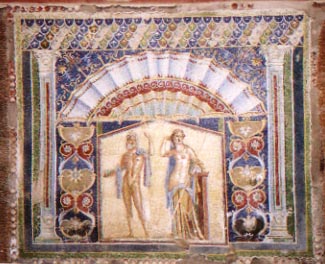
The history of mosaic goes back some 4,000 years or more, with the use of terracotta cones pushed point-first into a background to give decoration. By the eighth century BC, there were pebble pavements, using different coloured stones to create patterns, although these tended to be unstructured decoration. It was the Greeks, in the four centuries BC, who raised the pebble technique to an art form, with precise geometric patterns and detailed scenes of people and animals.
By 200 BC, specially manufactured pieces ("tesserae") were being used to give extra detail and range of colour to the work. Using small tesserae, sometimes only a few millimetres in size, meant that mosaics could imitate paintings. Many of the mosaics preserved at, for example, Pompeii were the work of Greek artists.
The mosaic here shows the god Neptune with Amphitrite (on the right) and is in Herculaneum, Italy. It is a wall mosaic which uses pieces of glass to give the vivid colours and reflect light. Glass was not suitable for floor mosaics. Here, the tesserae were mainly small cubes of marble or other stone. Sometimes bits of pottery, such as terracotta, or brick were used to provide a range of colours.
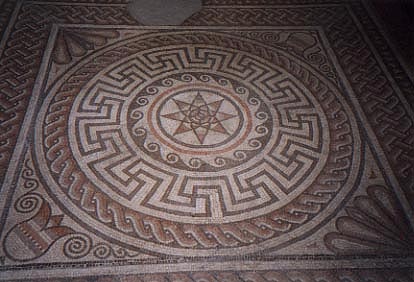
The expansion of the Roman Empire took mosaics further afield, although the level of skill and artistry was diluted. If you compare mosaics from Roman Britain with Italian ones you will notice that the British examples are simpler in design and less accomplished in technique.
Typically Roman subjects were scenes celebrating their gods, domestic themes and geometric designs. The inter-twined rope border effect here is called "guilloche".
This mosaic is in the museum at Winchester, Hampshire, UK.
Byzantine mosaics
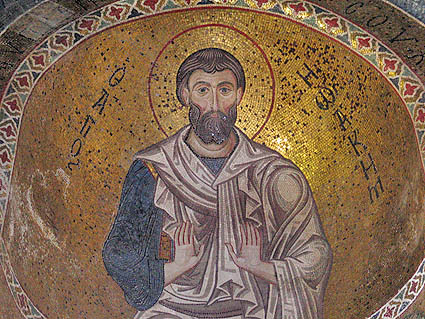
With the rise of the Byzantine Empire from the 5th century onwards, centred on Byzantium (now Istanbul, Turkey), the art form took on new characteristics. These included Eastern influences in style and the use of special glass tesserae called smalti, manufactured in northern Italy. These were made from thick sheets of coloured glass. Smalti have a rough surface and contain tiny air bubbles. They are sometimes backed with reflective silver or gold leaf.
The mosaic below is from the ceiling of the baptistery in Florence, Italy. Other spectacular examples can be found in Ravenna, Venice and Sicily and in Istanbul.
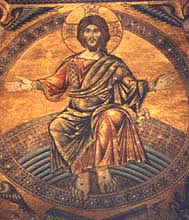
Whereas Roman mosaics were mostly used as floors, the Byzantines specialised in covering walls and ceilings. The smalti were ungrouted, allowing light to reflect and refract within the glass. Also, they were set at slight angles to the wall, so that they caught the light in different ways. The gold tesserae sparkle as the viewer moves around within the building.
Roman images were absorbed into the typical Christian themes of the Byzantine mosaics, although some work is decorative and some incorporates portraits of Emperors and Empresses.
Islamic mosaic art
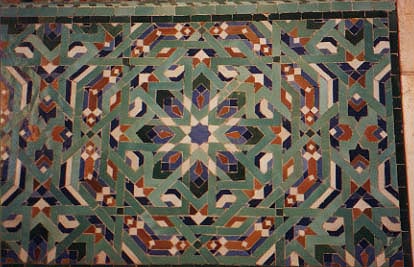
In the west of Europe, the Moors brought Islamic mosaic and tile art into the Iberian peninsula in the 8th century, while elsewhere in the Muslim world, stone, glass and ceramic were all used in mosaics. In contrast to the figurative representations in Byzantine art, Islamic motifs are mainly geometric and mathematical. Examples can be seen in Spain at the Great Mosque at Cordoba and the Alhambra Palace. In Arabic countries a distinctive decorative style called zillij uses purpose-made ceramic shapes that are further worked by hand to allow them to tessellate (fit together perfectly to cover a surface).
The British Association for Modern Mosaic has an excellentlist of sources on ancient mosaics.
Found objects have been used as mosaic materials in a range of ways, for example in Victorian shell grottoes and "putty pots", where china and other items (buttons, toy figures etc) are stuck to a base with linseed putty. This kind of collage of personal objects with connections to everyday life is also sometimes called "memoryware".
Mosaic history, part 2 - Medieval to modern
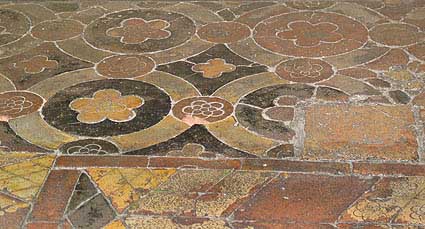
In the rest of Europe, mosaic went into general decline throughout the Middle Ages. However a flourishing tile industry led to mosaic tiling patterns in abbeys and other major religious buildings, for example. These tiles from Prior Crauden's Chapel at Ely Cathedral date from around 1320. The floor of the Chapel features a detailed tiled scene of Adam and Eve. As well as the interlocking patterns of tiles, there are some other mosaic techniques, including pseudo mosaic and opus sectile
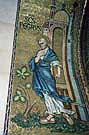
In the 19th century there was a revival of interest, particularly in the Byzantine style, with buildings such as Westminster Cathedral (left) and Sacre-Coeur in Paris. In Britain, this was fuelled by the concentration of wealth that the Victorian era brought, with increased domestic and public building projects. New techniques for mass-producing tiles meant a renewed of interest in decorative floors. The Gothic Revival in architecture and design looked back to medieval themes – and this was reflected in the way tiles and mosaic were used. Another industrial influence was Antonio Salviati, who is credited with breathing new life into the Venetian glass industry. He saw the business opportunity in matching the ancient skills practised in Venice with the Victorian demand for glass mosaic.
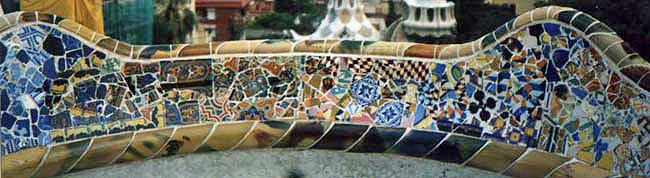
The Art Nouveau movement also embraced mosaic art. In Barcelona, Antoni Gaudi worked with Josep Maria Jujol to produce the stunning ceramic mosaics of the Guell Park (below) in the first two decades of the 20th century. These used a technique known as trencadis in which tiles (purpose-made and waste tiles) covered surfaces of buildings. They also incorporated broken crockery and other found objects, a revolutionary idea in formal art and architecture.
Found objects have been used as mosaic materials in a range of ways, for example in Victorian shell grottoes and "putty pots", where china and other items (buttons, toy figures etc) are stuck to a base with linseed putty. This kind of collage of personal objects with connections to everyday life is also sometimes called "memoryware".
A very influential site has been La La Maison Picassiette (in Chartres, northern France), the idiosyncratic work of Raymonde Isidore between 1938 and 1964. As a middle-aged manual worker, he covered his entire house and garden with intricate mosaics of broken crockery. His nickname ("Picassiette") came from a French expression meaning a "scrounger": This expression - "pique assiette" - is the name given today to this very popular style of mosaic.
Modern mosaics
Mosaic is in a healthy state in the early 21st century, despite a tendency for it to be thought of as more the work of craftspeople than artists. Perhaps this is a difficulty in accepting the fact that mosaics often have a dual function, for example as flooring, and also because it is a very accessible, non-elitist form of creativity. The field is rich with new ideas and approaches, and organisations such as the British Association for Modern Mosaic and The Society of American Mosaic Artists exist to promote mosaic. BAMM has an excellent list of sources on ancient mosaics. The worldwide web gives access to a great many artists working in this medium.


